Pages

Showing posts with label nature. Show all posts

Wednesday, 14 November 2018

Outdoor Inspiration from I Ur och Skur preschools

In October I visited two I Ur och Skur preschools on Lidingö, just outside Stockholm City.
I Ur och Skur means directly in hour and shower (UR is an old word for clock, or a word outside, or original as urskog means virgin forest (original untouched forest) - it can also be translated as the saying Rain or Shine - as in come rain or shine = no matter what.

The preschools we visited were Stubben and Mulleborg... Mulleborg being the first ever I Ur och Skur preschool.

What I really liked about visiting, aside from the fantastic grounds, the usage of the local nature and the enthusiastic and respectful staff was the fact there was a healthy relationship with the outdoors and indoors. These were not places that MADE the children be outside everyday all day, these were places that made the outdoors an attractive place to be so the children wanted to be there...
there is a huge difference.
The indoor area was used just about every day, and in a way that supported the children's enthusiasm for being outside.
The outside, the connection with nature was the focus but not to an extent that the children had to be outside.
Of course the preschools were successful, the children loved being outside.
The preschools chose to not have large numbers of children... so both preschools had a huge space (especially their outdoor spaces) in relation to the number of children. They also had enough staff to be able to give the attention to detail that nature requires. This allowed them to go in different size groups into the forest to explore without compromising safety. This means it gives children the space and time to engage in risky play without it being dangerous.

This is NOT forest school... this is not about schoolifying nature... this is about supporting the children to have positive relationships with nature, to play and learn naturally there, as they would anywhere else (of course in nature there is more freedom... and it can be forest, a meadow or a lake... not confined to school in a forest..)

Don't get me wrong it is GREAT that schools are getting out into nature and discovering children can learn there... discovering there is more than one way to learn.
But in a way this is something children already know... maybe forest school is more about educating adults into understanding transdisciplinary learning, new perspectives on learning, and the 100 language of learning... not JUST in a classroom with workbooks and "set activities" - a kind of controlled play.
Forest Schools are important in many places because they are that first step for the school system to learn that traditional school is not the ONLY answer.

But what I saw in these preschools was play, learning happening and being supported through play, freedom, social interactions being supported allowing for socially competent children (they have the space to develop at their own space, and not being forced into social situations before they master the skills/confidence due to small indoor spaces).

I also saw staff that believed in what they are doing, and also had a great joy for the outdoors... which sadly is not always the case, even in most Swedish preschools where I have encountered at least one (often more) pedagogues at every preschool I have spent real time at, that have not liked going outside. And this infects the children.
Creating a joyful and good relationship with the outdoors and with nature is essential. On that learning can be built.
If the children are negative or do not feel safe or inspired, then the learning and the play is never going to be as deep or as profound. Or of the kind desired by the Swedish School Authority - "Life Long Learning"

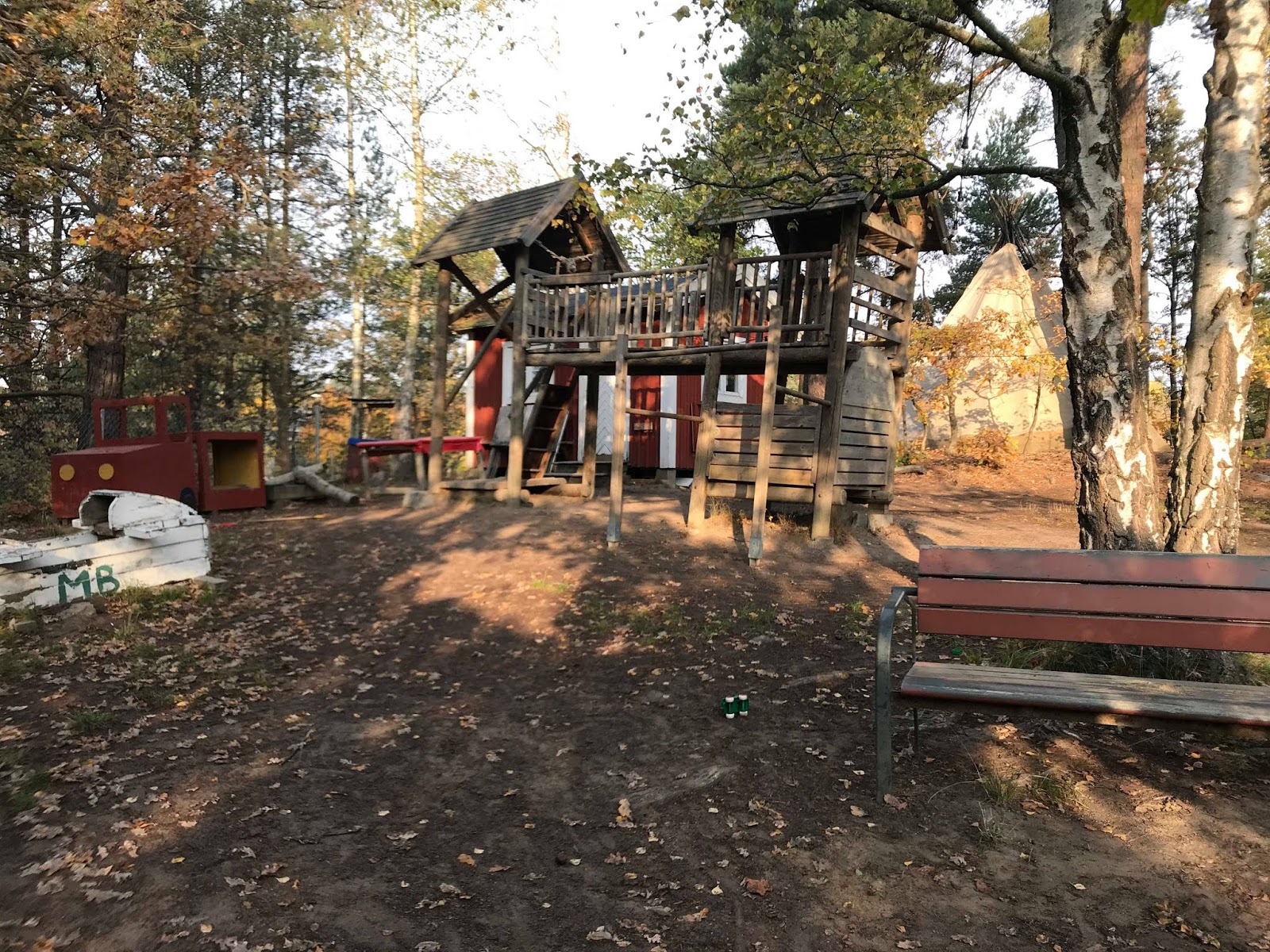
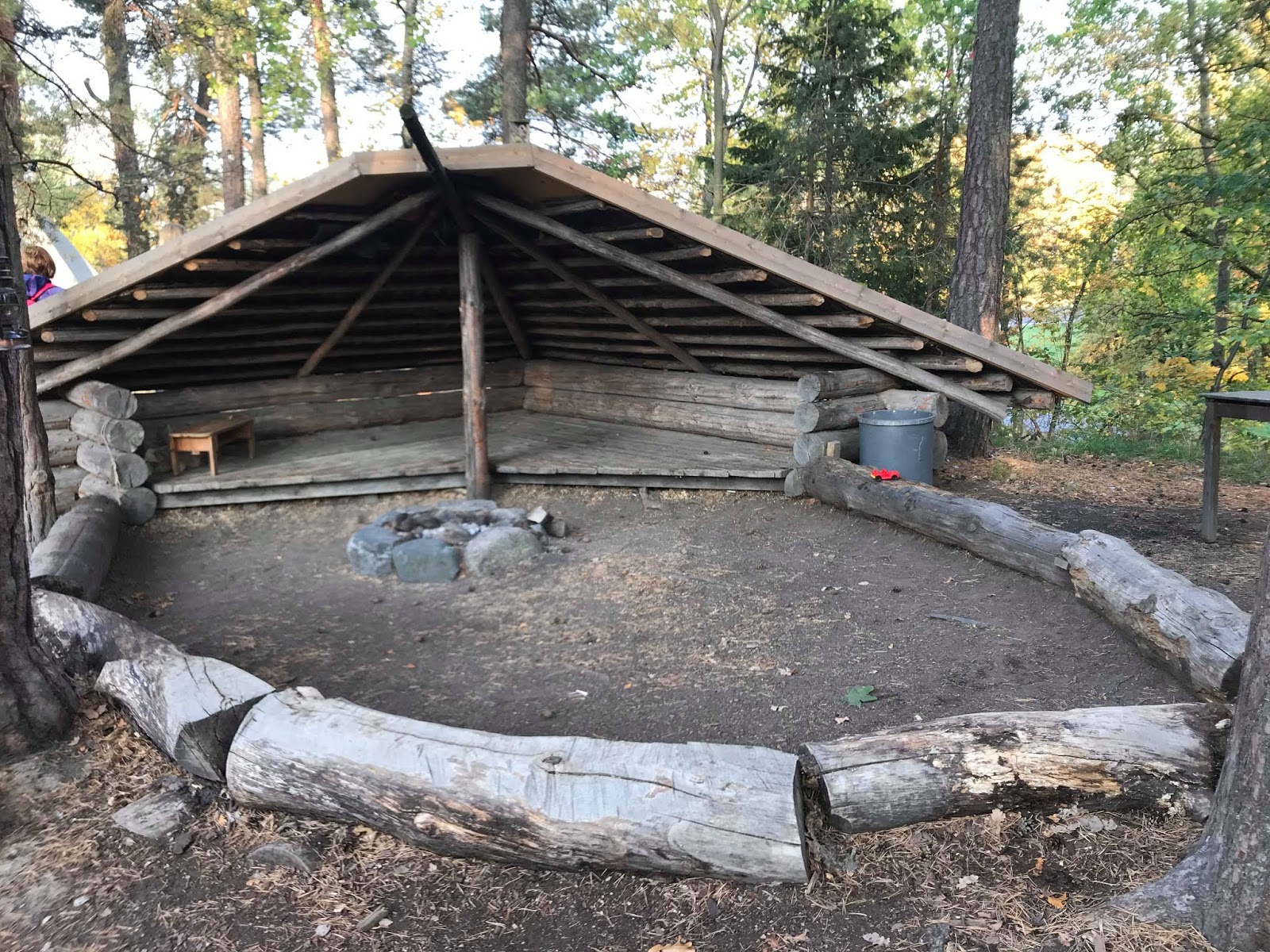
So here are some photos of the outdoor spaces to get you thinking
I fully realise not all of you will be able to create the same thing... lack of space, or policies that restrict. BUT the images can still inspire you to think what you can do in your own context.

The images are in no specific order... and in this post there will be no comments.
Tomorrow I will share some of these photos again, with comments and reflections.






Friday, 19 October 2018

Visit to Förskolan Tjädern (Preschool Ptarmigan)

This week I visited several preschools together with Niki Buchan and a group of fabulous educators from Great Britain. I almost wrote last week, as I feel I have done so much this week it could not possibly have fitted it all into one week.

Over time I will be sharing some of the images and my reflections of those visits, but as I head to Palestine and Israel next week my focus after this blogpost will be on my preparations for there.

Last Monday afternoon we went to Förskolan Tjädern in Haninge.
Since I had been to the Border Crossing exhibition it was very clear that this exhibition had influenced them. The preschool was spiced with nature and technology working together for the children to explore and play with.

The other main thing that struck me as I walked around the setting was the energy of the staff working there. They seemed happy and eager to share their important work with us... it is always an absolute joy to see educators being proud of their work. And so they should be. The children were all busily engaged in an array of activities.

The photos I share below may look like the preschool was empty, but I was cleverly trying to avoid having children in the frame...

as you can see in just about every room the children had access to natural materials to explore and play with, and in different ways... you felt the hundred languages... not one way to explore nature

furniture was customised to meet the needs of the preschool and to support the play and learning. A small raised surface to build on allows the pieces to remain and the floors still to be cleaned, and at the same time makes it easy for several children to reach and interact on. And for the youngest children I wonderful platform to sit on and build, or crawl over or jump off (if no others are using it to build on) it is a suitable risk for one year olds. No danger, but the wonderful tickle of excitement if jumping off when new at jumping.

the one year olds had plenty of small spaces to climb into... all the rooms had small spaces for the children to hide away in, but it was lovely to see that in the one year old room the spaces were really small... adapting to the smallness of their bodies... creating a cozy space, but also the physical challenge of getting in and out. My own son simply adored to be squashed up in shelves like this... as have many many children I have worked with... including much older preschoolers!

space to explore nature with digital media... microscope egg to see details... using the i-pad to make films and take phtos of the close-ups

the children in the preschool had access to many of the same materials throughout the preschool, regardless of age. The difference was that in the younger years where small parts can present a hazard for some children who are in a very oral phase the small loose parts were put up high on a shelf so that they could be brought down to work with the children when an educator was sat along side to support the process and ensure nothing dangerous happened. One year olds working with toothpicks is a good risk together with a guiding adult.

I also appreciated how windows were being used, with shelves along them, so that natural light lit up the materials. It also created a well lit play-space. Of course here in Sweden we have to maximise that daylight as in winter there are not many hours of it.

the natural light also contributed towards making shadows... this made having a construction area by a window extra dynamic. There is also a lot of up-cycling and recycling materials being used.
Plastic is used too. it is not a taboo if it has a valid play and learning purpose.

getting the children involved in making learning materials.

another construction area... this time for the youngest children and with wheels and movement as a focus
instead of just a flat surface to drive vehicles on blocks had been put underneath to create a variety of heights... small hills for the vehicles... and to strengthen small hands as they drive up them, and wonder as they roll down...

here the youngest children have a small patch of living grass to play around and with

different phenomenas to explore... not just natural, but man-made too

many of the role-play areas had different themes, with natural elements and forest etc being observed mostly. This was the only "traditional" style role-play space and it was in the one year old's space. I liked the idea of creating a space that reminded them of home at a time when they are first transitioning between home and preschool. It makes sense for them to play here and to feel safe... and as they get older then their play gets more daring, as the preschool space is familiar.


a homemade light table to construct on

another version of a home-made light table... this time more like a light-bin, so all sorts of sensory materials can be used in it.

a small world area for play

art studio for the older children with lots of materials easily accessible
art studio for the youngest... less overwhelming with materials. The small parts are, as I mentioned before, kept high on a shelf and brought down to work with the children with guidance... a healthy risk and not a dangerous hazard. Children are given the time to master materials so that when they are older they can have free access to them all.


sensory play

the window sill as a work surface. I have worked with so many children who love to play in the window. My own three children loved to do this at home... and my mother reported that when I was a young child this is where I did most of my playing... on the window sill. Maybe children are like flowers and search out light to grow and evolve?

severla rooms use projectors to inspire.


the absolute joy of dry rustling leaves to play with inside... sounds, smell, touch... and to observe how the leaves with eventually crumble... This room had a board across the doorway so that the leaves did not escape and end up everywhere.


digital and analogue crossing borders...

the simplicity of the younger rooms to allow them to develop relationships with the materials at their own pace

a rich variety of loose-parts to construct with.


a mini-atelier, using the natural light to its fullest
The educators here are in a process, they tell me... this is not the final product of a preschool, but just the start of a journey to understand how to create a preschool for all children... so they all feel included, they all can express their ideas, they feel valued, and learn to value others... the third teacher is their colleague to help them with this journey.