Pages

Showing posts with label holistic. Show all posts

Wednesday, 14 November 2018

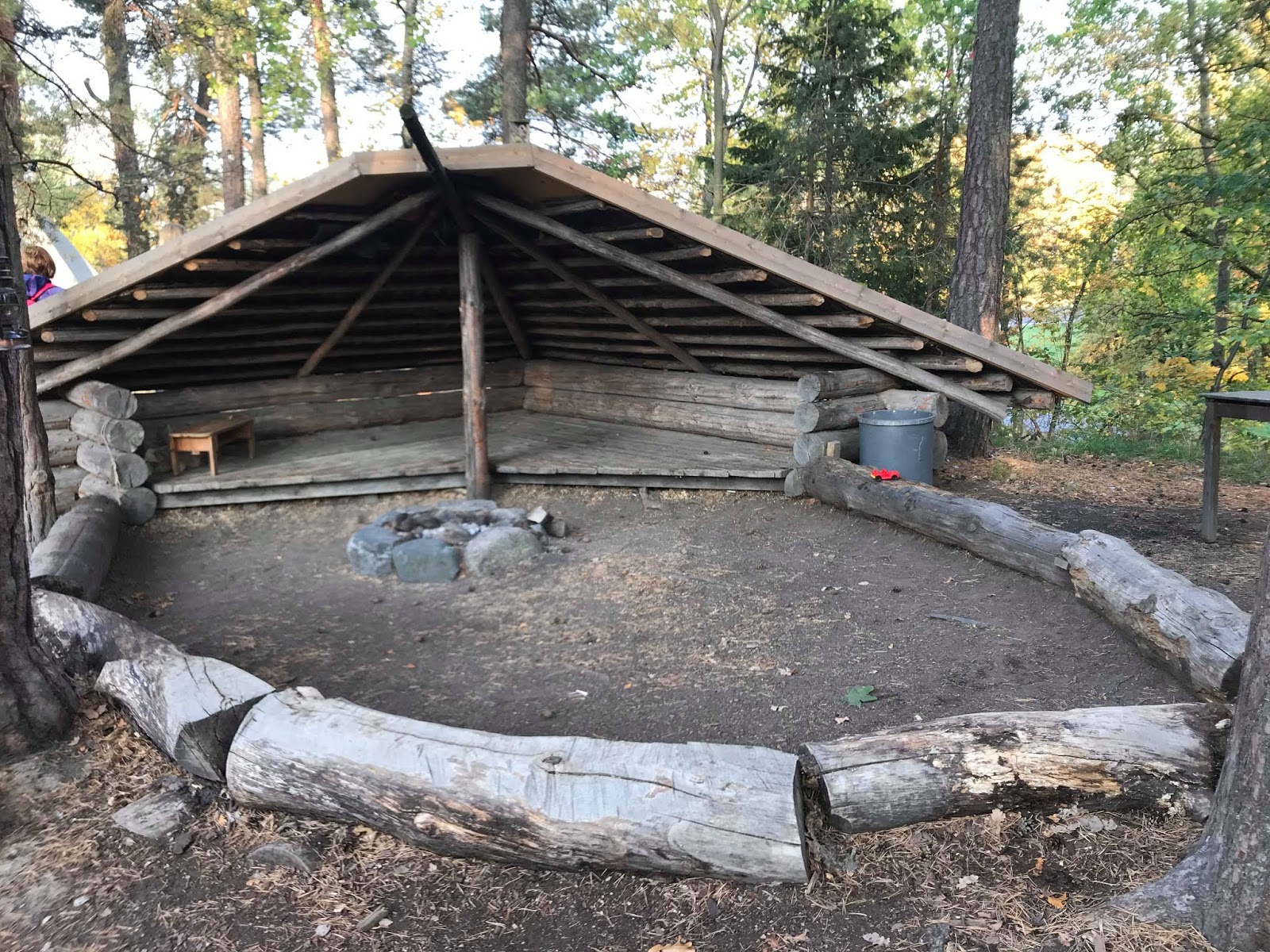
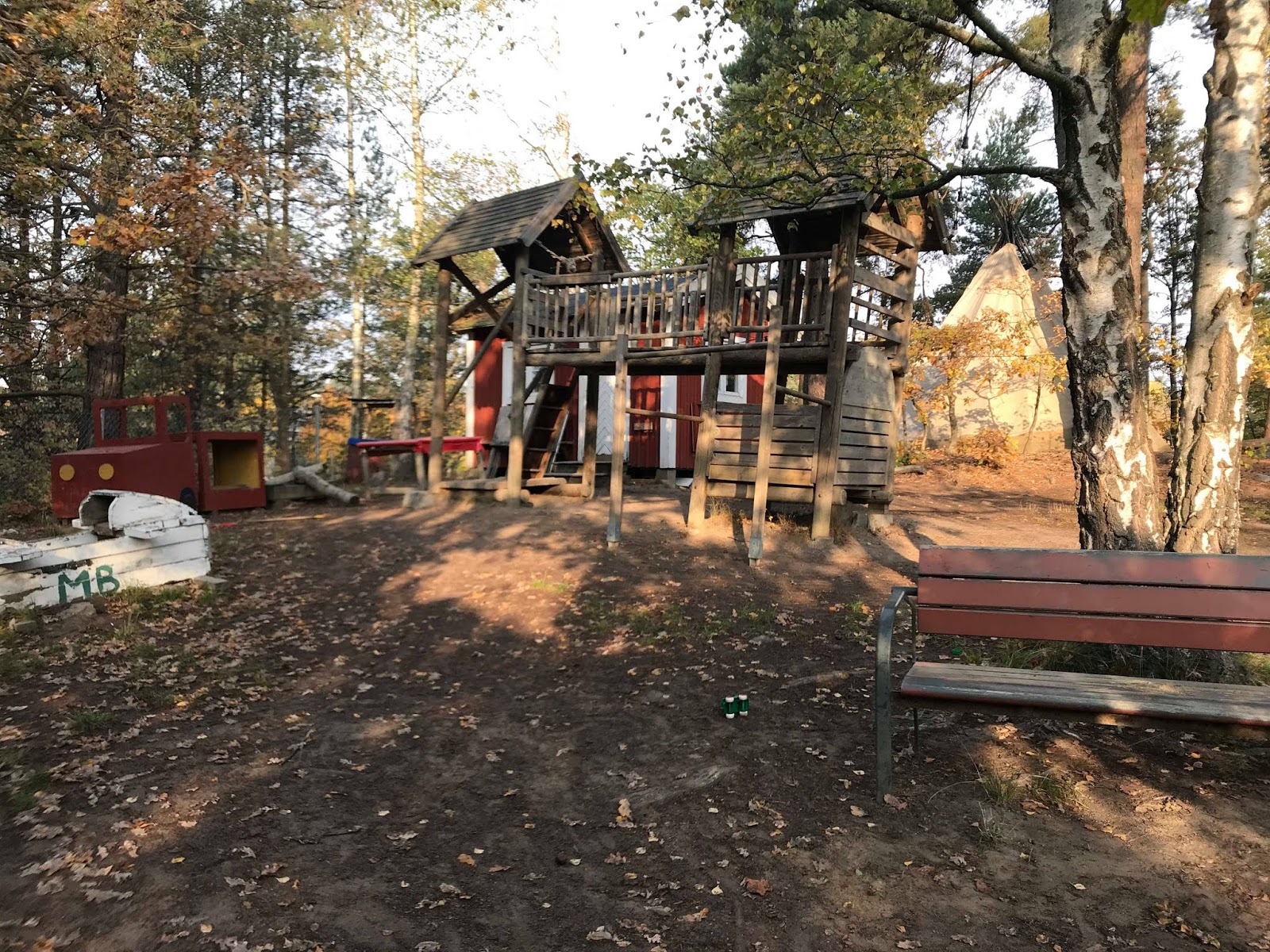
Outdoor Inspiration from I Ur och Skur preschools

In October I visited two I Ur och Skur preschools on Lidingö, just outside Stockholm City.
I Ur och Skur means directly in hour and shower (UR is an old word for clock, or a word outside, or original as urskog means virgin forest (original untouched forest) - it can also be translated as the saying Rain or Shine - as in come rain or shine = no matter what.

The preschools we visited were Stubben and Mulleborg... Mulleborg being the first ever I Ur och Skur preschool.

What I really liked about visiting, aside from the fantastic grounds, the usage of the local nature and the enthusiastic and respectful staff was the fact there was a healthy relationship with the outdoors and indoors. These were not places that MADE the children be outside everyday all day, these were places that made the outdoors an attractive place to be so the children wanted to be there...
there is a huge difference.
The indoor area was used just about every day, and in a way that supported the children's enthusiasm for being outside.
The outside, the connection with nature was the focus but not to an extent that the children had to be outside.
Of course the preschools were successful, the children loved being outside.
The preschools chose to not have large numbers of children... so both preschools had a huge space (especially their outdoor spaces) in relation to the number of children. They also had enough staff to be able to give the attention to detail that nature requires. This allowed them to go in different size groups into the forest to explore without compromising safety. This means it gives children the space and time to engage in risky play without it being dangerous.

This is NOT forest school... this is not about schoolifying nature... this is about supporting the children to have positive relationships with nature, to play and learn naturally there, as they would anywhere else (of course in nature there is more freedom... and it can be forest, a meadow or a lake... not confined to school in a forest..)

Don't get me wrong it is GREAT that schools are getting out into nature and discovering children can learn there... discovering there is more than one way to learn.
But in a way this is something children already know... maybe forest school is more about educating adults into understanding transdisciplinary learning, new perspectives on learning, and the 100 language of learning... not JUST in a classroom with workbooks and "set activities" - a kind of controlled play.
Forest Schools are important in many places because they are that first step for the school system to learn that traditional school is not the ONLY answer.

But what I saw in these preschools was play, learning happening and being supported through play, freedom, social interactions being supported allowing for socially competent children (they have the space to develop at their own space, and not being forced into social situations before they master the skills/confidence due to small indoor spaces).

I also saw staff that believed in what they are doing, and also had a great joy for the outdoors... which sadly is not always the case, even in most Swedish preschools where I have encountered at least one (often more) pedagogues at every preschool I have spent real time at, that have not liked going outside. And this infects the children.
Creating a joyful and good relationship with the outdoors and with nature is essential. On that learning can be built.
If the children are negative or do not feel safe or inspired, then the learning and the play is never going to be as deep or as profound. Or of the kind desired by the Swedish School Authority - "Life Long Learning"

So here are some photos of the outdoor spaces to get you thinking
I fully realise not all of you will be able to create the same thing... lack of space, or policies that restrict. BUT the images can still inspire you to think what you can do in your own context.

The images are in no specific order... and in this post there will be no comments.
Tomorrow I will share some of these photos again, with comments and reflections.


Friday, 13 July 2018

The story of a hug...

I recently read a short article about the benefits of hugs (touch) and babies... and just how it impacts the brain and development of the child.
The post was shared in a group about early childhood education as a reaction to the fact that some settings are writing no-hug policies.
And while I think physical contact is incredibly important to the well-being and development of each child, I also think we cannot just go round hugging every child as a pedagogical plan to develop their brains... we need to think about consent.
As a person who does not like hugging all that much, and also the mother of children where hugging/touch is not something they are keen on outside of the family I think we have to be aware of how we reach out to others.

As an early years educator I have learned to hug and touch to me the needs of the children... it has come out of empathy and an intellectual place. I have a huge respect for children who do not want to be touched and will wait for a signal, or will gently test to see if a hand on an arm, or holding a hand is what they need... sometimes it is just about sitting next to them... that is contact enough.

A hug or touch is a sensory experience. And if you are a person that is easily sensory overloaded then it can be difficult to appreciate the intentions of the hugger as all you focus on is the overload sensory experience and how to deal with that.

I have worked with children that have needed a firm hand rather than a light touch - the firmness was a better feel than the light touch which triggered a kind of discomfort - some children love to be tickled... others experience it as pain. I worked with one child that would stim a lot when very excited... hands waving so much she was unable to eat her apple, but if I applied pressure to her back in an up and down movement she was able to release the joy through me and focus on her apple. The moment I stopped was the instance the stimming started. I have no problem with stimming, but it was getting in the way of her eating her apple with the other children, and this small gesture enable her to be included in the group activity.

I think what it boils down to is love.
Jools Page has researched and written about Professional Love which I have written about on numerous occasions on my blog over the years. This is such an essential part of working with people.
Not just young children... but all people.
I think if we are coming from a place of professional love then we are going to be incorporating consent too, it is about showing care for the whole child/person and being aware of their emotional needs... understanding when a hug and when touch are essential to enabling the child to develop and reach their own potential, and also understand what form of touch is the most supportive and caring and respectful in the situation.

Today I read about children (albeit older ones) receiving electric shocks in a school in Massachusetts as part of their education... to condition them... and from what I can gather it is clear that the shocks are not being used in a therapeutic way but more as a way of control and punishment.  Professional love should be something that is used throughout the education system.
We see the lengths teachers go to protect their children in USA and the awful mass-shootings in schools... it is clear that professional love happens... but maybe it should become more official.

If you explore what the word love means you will see there is great diversity in its definitions... but essentially it involves caring for, or identifying with another. Also as I explored love I cam across the chinese word REN... Confucius never apparently completely defined it, because of its diversity... but it kind of comes back to love, humanity and interactions with others. Which is what we want for our children in schools... and this can mean touch and hugs.

There is the science (neuroscience) to back up the effects of touch - there is research about the catastrophic effects of when children do not get the physical contact that they need... (see links below)...

we need to ensure we are meeting the needs of the WHOLE child.


other links for further reading
Tracey Seed - Cuddling
Not touching - likened to child abuse
På svenska - in Swedish... research projects about touch in preschools - necessary or bad?
No touching kids policies is good for teachers - not quite the text I was expecting to read... as it seems to be written by a person who does not like being touched, but still important to read.
Losing Touch - how teachers are afraid to have physical contact with children in their care.
What the lack of affection can do to you
The Influence of touch on child development
The human touch: a neglected feeling - the importance of touch throughout life
Touching Empathy - that lack of physical touch can actually kill babies...

Saturday, 30 June 2018

The Benefits of BIG play

I have regular contact with the educators from Jenin, Palestine - sometimes to ask about things, sometimes to share what they have been doing, and sometimes just to say hello, how are you doing?

Yesterday I received a series of photos of children playing on old tires and the comment that she (the educator) had been preparing the setting as the children arrived, but the children came and took over... and the surprise to see them playing, learning and enjoying themselves despite her concern.
We have talked a lot about risky play and the benefits this has for children's ability to do their own risk assessments, rather than being dependant on an adult to judge what is safe - of course we do not want to expose them to danger, only to situations that allow them to learn - a small scratch or bruise will not hurt much or for long but can provide an enormous lesson for the child about what is safe and what is not... and how much their own body is capable of.

I also got to watch some films of the play sessions.. which I will not show here, and although I am not particularly good at Arabic (its words rather than full sentences) I was able to pick out the "careful" was being said many times.

BIG play like this is a test for the adults just as much as the children. What are WE capable of allowing the children to experiment with themselves before we come and wrap them in cotton wool. I think it is a human instinct to want to protect our children... but sometimes too much protection can mean we send them out into the world unprepared. We have to learn balance.


In the photos below we can see some of the learning that is going on (I am of course privvy to more photos and films, the teachers there were able to see even more of the action, play and learning)

The learning that I can see is that the children are learning how to interact together... the films in particular showed how stacking the tires was hard for one person to do, they needed to collaborate, together they are stronger. They learned about physics - how the wheels moved, which directions and movements made it easier to move them around, which directions were harder, they learned about gravity and stability. Maths comes into it... how many tires can they manage to stack, how many is possible before it becomes unstable, if they are making stacks of three then they can start thinking about their three times table... multiplication - three towers of three are nine tires... all of this is happening naturally in their play. Since the tires are painted they can think of patterns and design.

Then there is the physical learning - the children strengthen their hands and arms... to be able to hold a pen to write children need to to have the muscle strength... BIG play allows the WHOLE body to be strengthened - because reading and writing (what many traditionally see as "learning" ) requires a child to be able to sit at a desk and hold their pen and concentrate... this big play is giving them the training they need to be able to do that... and even when in school this kind of BIG play is still needed to maintain muscle and concentration - we all know that if we stop training or stop speaking a language that we become less good at it, or weaker... it is the same with learning... too much focus on academic learning means that the whole child's needs are not being met... PLAY is essential for all ages to ensure there is the physical and mental well-being to learn - and also as you have just read above, learning is also happening in play.
Far too often there is an intense focus on forcing the child to sit, be quiet, and learn certain things in a certain way - learning is much more complex than that.
There is a phrase/word in Swedish called "studiero" which translates to study peace... ie there is peace in the classroom to be able to learn.
The thing is that this is being interpreted as being quiet... that children need to sit in silence or use hushed voices to be able to learn. And I seriously question this... is learning always quiet?
my experience is that it can be all sort of things... sometimes it is total silence as the children are fully engaged/mesmerised - other times it is extremely noisy as the children explore, discover and are excited about the learning. Sometimes learning happens individually and requires a muted space while other times it is in groups and is a lively dialogue, or even at times a heated one... As teachers/educators we need to be aware that we are creating learning spaces - this is not the same as "learning peace". We need to be aware that children not only learn in different ways from each other... they also need, on an individual basis, a varied learning diet. Sitting at a desk learning by listening only to the teacher and repeating what the teacher says is like eating only boiled rice and beans every day... yes, you can survive on it, it gives you energy and nutrients - but after a while you become disinterested in it, especially when you can see all around you other options. We need to give children a varied learning diet... and this means generous servings of play... the WHOLE child. My posts on Original Learning will describe in more detail how learning and play are woven together and should not be separated.

What do we want for our children?
What IS it we want them to learn... to achieve? What does the future hold for them? And how is school actually preparing them for that? By giving them the same skills we got last century? or by giving them the skills they need to look forward, imagine and solve the potential problems of tomorrow?
As Einstein said -

"Imagination is more important than knowledge. For knowledge is limited to all we now know and understand, while imagination embraces the entire world, and all there ever will be to know and understand." Schools trades in knowledge... what is already known... and yes this is useful, but it is only part of the story. Children need imagination... and that is best supported by play...


I have been reading Alison Gopnik over the last few days about how the very youngest children learn - the importance of play, the importance of interaction and the importance of the adult actually understanding how children learn rather than just filling them with information and sticking to what has always been done.

BIG play allows the whole child to learn... their entire body becomes involved. Mixed ages in this big lay allows the children to learn about taking care of each other, it also allows the youngest children who maybe do not have the muscle strength yet to participate in all of the play, the chance to observe and develop strategies - by watching they can see the interactions of others, they access social learning, they also get to observe the materials - science, technology, maths all of these can be observed. By interacting with each other the children are developing the language skills, by constructing together they are learning how to communicate spatial awareness, make predictions with each other and test them out... these are science experiments - what works what does not work.

BIG play also lets the child to enjoy themselves... and in this joy it is easier to feel safer, to connect with others and also to learn. As Malaguzzi said "Nothing without joy". We do not have to make learning fun... what we need to do is awaken the joy within each child to learn. Play is a fabulous way to awaken that joy... play is exploring, experimenting, testing, discovering, repeating, developing etc etc...

The adult needs to take a step back and allow uninterrupted play. Observe. Is there anything the children need to develop their play further... can this be provided in a story read later, or by offering small blacks to build with, or by asking some questions, or maybe showing  a small film to stimulate their construction.
The teacher invites the child to try something new, or provokes the group into thinking deeper... and then gives the children the space to test out the new and the deeper thoughts.

My time working with 8-13 year olds allowed my to understand that children appreciate learning from each other... they appreciate being trusted as competent... they appreciate being supported by educators who provide them with information, ways to find information and activities that allow them to discover learning so much more than sitting in a room having to just accept what a teacher says.
They want to learn with, talk with the teacher... not be talked at.

useful links
Peter Gray - Risky Play... Freedom to learn
The importance of outdoor play
Original Learning - my blog
Play spaces and play - giving children the freedom to play (my blog)
redefining play and education - we need to look at what the words mean
Malaguzzis three children - what kind of teacher are YOU... how do YOU view the child?
Together play - learning together by playing together
Purposeful play
Climbing Trees- to do not not to do - risky play

This is not an exhaustive list of links... there is much to read about the benefits of play, or risky play and outdoor play.
Also the above does not list everything that can be learned through play...

 with thanks to Suzan for the permission to use the photographs
you can find out more about her preschool "Best Of" early years center, Jenin, Palestine  by checking out their facebook page (click the link, which is the name above) - they are a setting that is striving to create  a place for children to learn through play, which is not a common feature of the local area where learning is very much seen as academic and rote.
So a huge applause I sen to them for their efforts to create the best learning environment for children, so that the children are ready with mind and body to face whatever the future holds for them. They do this despite not all understand the importance of play and put pressure on them to teach the way it has always been done.
Its not easy to do what is right... we have to be BRAVE.


Thursday, 14 June 2018

Children's Rights - Barnens Rättigheter (The future of preschools, part 3)

(på svenska efter bilden)

It seems like quite a coincidence that as I write this series of posts about the future of preschool, with a focus on democratic learning and  the whole child, that Sweden has just made the decision that the articles agreed upon in the convention of children's rights is to become Swedish law from 1st January 2020.

So what does this mean for the future of preschools in Sweden... that are already obliged to follow the articles from the children's convention...

I am a very strong believer in the rights of children... well in the rights of all people... but the problem with making this law is that the implications can be rather drastic... or at best might mean little change at all.

I have been reading various articles this morning... and far from all are positive about this decision... not because they do not believe in the rights of children, but because they do... and they feel that this is a shallow move done to please the popular masses, rather than a genuine move to ensure the rights of children. The reason given is that the articles are too vague and leave to much to be interpreted, and therefore the children are at the mercy of adults and their ability to interpret the text. And when I see the massive variety in how the Swedish preschool curriculum is interpreted today that is actually a terrifying thing... there are preschools that do amazing work with children, but there are those that have interpreted the curriculum in a different manner and the quality is far from desirable...
The critics wish that children's rights are protected by more relevant laws, laws that support children in a Swedish context based on knowledge gained from experiences here in Sweden (and elsewhere).

So how will it impact the preschool and the school of the future... this new law?

Well article two is about that children should not be discriminated against and article three is about ensuring the best for each child...
Just in these two articles many preschools (and even more so schools) are going to struggle upholding the law - as a mother of autistic children I can see the difference between a child that receives  what is best and one that is not for the best... one of my children has received the support she needs cognitively (she did not get adequate support in her previous school socially - as there was a great deal of homophobic slurs penetrating the school atmosphere... as well as sexism racism etc... and despite the school trying to intervene, these were more events than genuine work with the social climate) - my other child with autism is forced to go to a school that is ill-equipped to meet his needs - the law in Sweden makes it compulsary for a child to attend school regardless if it is "the best interests of the child" or not... My son is bullied by class-mates, teachers and the system that fails to provide an education that he can access... so does this mean that in 2020 the school is breaking the law? technically they should be following the child convention now - and yet it has little impact on my child and thousands of other children (I am a member of several Swedish support groups for parents of autistic and ADHD children - and most seem to have the same story... and the tragic part is listening to the stories of these parents in international groups... this is a worldwide failing to meet the needs of children..)
I have worked and visited preschools over the years that have also failed to meet the needs of these children... and this idea of equal value is such a surface thing that I sometimes want to scream. it is nearly always about making the "different" child understand and adapt to the norm, and far too seldom about supporting the whole group to understand and adapt to each other... to expand the norm and to create a real inclusive environment where all are really equally valued.

Don't get me wrong.
There is so much good with the Swedish preschool. There are many many amazing educators working with children - to support the children in the learning, development and being a part of our shared world.
but we also need to recognize the fact that preschool and school is an institution, this I have written in my last two posts about the future of preschool (all links at the bottom of the page). Preschool is primarily an institution to provide a service for the parents... and within the walls their are educators fighting and working tirelessly for the rights of children... their right to be seen, to be valued, to play, to learn, to their identity etc
But if we want to create a place of democratic learning we need to accept the fact that far from all children choose to attend preschool or school. We can attempt to make it as democratic as possible within the walls - we can even try to knock down those walls somewhat - but for it to be truly democratic the children would have chosen to be there.
This does not mean that children do not enjoy their time in preschool, by far the great majority that I have ever worked with have enjoyed coming to preschool (maybe not always for the long hours some have had)
When the educators from the teacher training course I held in Jenin, Palestine, came to Stockholm last year they kept repeating, with heads shaking, that it was child abuse to have children in preschools for such long days.
When I did my peer-reviewed reading about quality in preschool (for my masters) I read frequently about the length of time children should have access to early years settings... as it was clear that access was beneficial... but just about all research I read stated that three hours was enough, more than that did not have more benefit and that over 6-8 hours it could be detrimental.
Swedish preschools are open for 12 hours a day... this is to meet the needs of the working parents - not the children.
Most of Sweden allows children who have parents at home with a younger sibling 3 hours a day at preschool... except Stockholm, which used to have 6 hours a day, but now offers 12 hours a day. If research says 3 hours is enough to stimulate a child, then why the extra hours.
Sure, if a child is at risk at home then preschool is in the child's best interest... but should we treat every child as if they are at risk.

In my twenty-five years of working in Swedish preschools I have seen a shift from parents seeing preschool (or daycare before 1998) as a support to their family life to now seeing preschool as a must do and asking permission to have their children at home. For me the children should have the right to be with their parents as their primary caregiver... but for some children with long hours preschool has become their primary caregiver.
Only ten years ago the fashion in Swedish preschools was to take away keyworkers... all children were all educators responsibility... we were encouraged not to create those special relationships that research informs us are so essential in children's neurological development. I referred to Jools Page yesterday and "Professional Love" - but we can also refer to Mine Conkbayir, Alison Gopnik etc etc about the need for genuine relationships for children to feel safe and to enable learning and development.
If we are talking about in the best interest of children - then we need to be investing more in preschools and schools so that the educators get the right training, that the group sizes are adequate for the needs of the children...
for instance my son thrived in his first year of preschool, as it was him, an amazing educator who developed a loving and respectful atmosphere for him and the two other children (three children in the last 3 months of the year)... then he started in a larger group - now there were 20 children and four teachers... still brilliant ratios for children aged 2-6 - and the preschool was ONLY open between 8:30 and 16:30 (it was a parent co-operative and we made the decision that the children came first, not our work) - and while my daughters thrived my son struggled. It was too many people, to many transitions (which had been more of a flow when only 3 children - but are more structured when there are more) - there was too much stimulus. 

I think I cried most mornings as I left him there (being brave at the hand over stage - but breaking down half way to work - where I then started working with other children his age... at the time it made no sense... the state gave me money to put my child into preschool so that I could work in a preschool... it would have been nice to have had that money to stay at home and give him the same care and stimulation I was giving other people's children)...

Yesterday I wrote about how philosophy with children created a learning environment that was democratic and respectful, and that the whole week had to meet the needs of the whole child... in other words the philosophy sessions I did with them was not just about verbal communication - it was about communicating with the whole child. But it also taught the educator how to become a facilitator rather than a teacher... that it goes from teacher-centred to child-centred.
The word "undervisning" (teaching) will be introduced into the  Swedish curriculum, where only teachers will be able to hold these "lessons" - in a time when it is difficult to find preschool teachers, and some settings will be in the position of having too few teachers to be able to uphold the quality expected of them.

Other breaking news recently is that there is going to be reshuffling/changes in the school authority and school inspection (they cover preschools as well) - how will a new system be able to support the preschool in transition? Especially as already today, there are far to many setting that are not providing the quality they should be, for a variety of reasons (and mostly I feel it is poor leadership, lack of resources and not possessing the right competence for the situation they find themselves in - and too many people in preschools that have no childcare/teacher training at all - which means that those that do have need to support co-workers as well as the children and parents they work with)

Children's rights are so important. They are something that I strive for in my work... to enable them to see, know, understand and use their rights - and to be able to use their rights wisely and as part of a community, not in a bubble to make themselves feel good at the cost of others. Again this is why philosophy with children is so great... as it is about expressing personal opinions at the same time as learning about the opinions of others and how we are stronger together.

To be honest I am somewhat surprised by this post... I thought it was going to be a big celebration post of children's rights... and in a way it is... I am so happy that children's rights are being valued...
but I want this to be real, to be genuine and that these rights are truly valued and are not simply window dressing.


Det verkar som ett tillfällighet att när jag skriver denna serie av inlägg om förskolans framtid, med fokus på demokratiskt lärande och hela barnet, har Sverige just fattat beslutet att barnkonventionen ska bli svensk lag från 1 januari 2020. Så vad betyder detta för framtidens förskolor i Sverige ... som redan är skyldiga att följa artiklarna från barnkonventionen ... Jag tror starkt på barns rättigheter ... alla människors rättigheter ... men problemet med att göra denna lag är att konsekvenserna kan vara ganska drastiska ... eller kan betyda liten förändring alls. Jag har läst olika artiklar i morse ... och långt ifrån alla är positiva till det här beslutet ... inte för att dom inte tror på barns rättigheter, utan för att dom gör det ... och dom tycker att det här är ett ytligt beslut gjort för att behaga massorna, snarare än ett äkta drag för att säkerställa barnens rättigheter. Anledningen till detta är att artiklarna är för vaga och lämnar för mycket för att tolkas, och därför är barnen beroende på vuxna och deras förmåga att tolka texten. Och när jag ser den stora variationen i hur den svenska förskoleplanen tolkas idag är det verkligen en skrämmande sak ... det finns förskolor som gör fantastiskt arbete med barn, men det finns de som har tolkat läroplanen på ett annat sätt och kvaliteten är långt ifrån önskvärt ... Kritikerna önskar att barns rättigheter skyddas av mer relevanta lagar, lagar som stöder barn i ett svenskt sammanhang baserat på kunskaper från erfarenheter här i Sverige (och på andra ställen). Så hur kommer det att påverka förskolan och framtida skolan ... den här nya lagen? Artikel 2 handlar om att barn inte ska diskrimineras och artikel tre handlar om att säkerställa det bästa för varje barn ... Bara i dessa två artiklar kommer många förskolor (och ännu mer skolor) att kämpa för att upprätthålla lagen - som en mor till autistiska barn kan jag se skillnaden mellan ett barn som får det bästa och det som inte får det bästa. .. en av mina barn har fått det stöd hon behöver kognitivt (hon fick inte tillräckligt med stöd socialt i sin grundskola - eftersom det fanns en hel del homofobisk fulord som trängde in i skolatmosfären ... liksom sexism och rasism osv. och trots att skolan försökte ingripa, var det mer som händelser än äkta arbete med det sociala klimatet). - Mitt andra barn med autism tvingas gå till en skola som är dålig utrustad för att möta hans behov - lagen i Sverige tvingar barn att gå i skolan oavsett om det är "i barnets bästa" eller inte ... Min son är mobbad av klasskompisar, lärare och systemet som misslyckas med att ge en utbildning som han kan komma åt ... det innebär också att skolan år 2020 bryta lagen? tekniskt borde de följa barnkonventionen nu - och ändå har det liten inverkan på mitt barn och tusentals andra barn (jag är medlem i flera svenska stödgrupper för föräldrar till autistiska och ADHD-barn - och de flesta verkar ha samma upplevelse av förskolan och särskilt skolan ... och den tragiska delen är när man lyssnar på historierna från föräldrar i internationella grupper ... man inser att det här är en världsomfattande misslyckande att tillgodose behoven hos alla barn ..) Jag har jobbat och besökt förskolor genom åren som också har misslyckats med att möta dessa barns behov ... och den här idén om lika värde är alldeles för ofta så ytlig att jag ibland vill skrika. Det handlar nästan alltid om att det "annorlunda" barnet måste förstå och anpassa sig till normen och alltför sällan om att stödja hela gruppen för att förstå och anpassa sig till varandra ... för att utöka normen och skapa en verklig inkluderande miljö där alla är verkligen lika värda. Misstolka mig inte. Det finns så mycket bra med den svenska förskolan. Det finns många många fantastiska lärare som arbetar med barn - för att stödja barnen i lärandet, utvecklingen och att vara en del av vår gemensamma värld. men vi måste också erkänna det faktum att förskola och skola är en institution, det här har jag skrivit i mina sista två inlägg om framtiden för förskola (alla länkar längst ner på sidan). Förskola är främst en institution för att tillhandahålla en tjänst för föräldrarna ... och inom sina väggar finns pedagoger som kämpar och arbetar outtröttligt för barns rättigheter ... deras rätt att ses, värderas, leka, lära, rätt till deras identitet osv Men om vi vill skapa en plats för demokratiskt lärande måste vi acceptera det faktum att långt ifrån alla barn väljer att gå i förskola eller på skolan. Vi kan försöka göra det så demokratiskt som möjligt inom väggarna - vi kan till och med försöka slå ner dessa väggar på något vis - men för att det ska vara verkligen demokratiskt skulle barnen ha valt att vara där.
Det betyder inte att barn inte tycker om sin tid i förskolan, den överlägset stora majoriteten som jag någonsin har jobbat med har gillat att komma till förskolan (kanske inte alltid de långa timmarna som vissa har haft) När pedagogerna från lärarutbildningen i Jenin, Palestina, kom till Stockholm förra året, sade dom ofta, att det var barnmisshandel att ha barn i förskolor under så långa dagar. När jag gjorde min peer-reviewed läsning om kvalitet i förskolan (för mina masters) läste jag ofta om hur lång tid barnen borde ha tillgång till förskolan... det var tydligt att tillgång var fördelaktig ... men all forskning som jag läste uppgav att tre timmar var tillräckligt, mer än det hade inte mer nytta och att över 6-8 timmar kan det vara skadligt. Svenska förskolor är öppna i 12 timmar om dagen ... detta är för att möta de arbetande föräldrars behov - inte barnens. De flesta kommuner av Sverige tillåter barn som har föräldrar hemma med en yngre syskon 3 timmar om dagen på förskolan ... förutom Stockholm, som brukade ha 6 timmar om dagen, men erbjuder nu 12 timmar om dagen. Om forskning säger att 3 timmar är tillräckligt för att stimulera ett barn, varför de extra timmarna? Visst, om ett barn är vid risk hemma, är förskola i barnets bästa intresse ... men ska vi behandla alla barn som om de är i fara? Under min tjugofem år inom svenska förskolor har jag sett hur det har skiftat från föräldrar som ser förskola (eller daghem före 1998) som ett stöd för deras familjeliv för att nu se förskolan som ett måste och begära tillåtelse att sina barn få vara lediga. För mig borde barnen ha rätt att vara med sina föräldrar som sin främsta vårdgivare ... men för vissa barn med långa timmar har förskolan blivit sin primära vårdgivare. För bara tio år sedan var det "mode" i svenska förskolor att ta bort "key workers" ... alla barn var alla lärares ansvar ... vi uppmanades att inte skapa de speciella relationer som forskningen informerar oss om är så viktigt för barns neurologiska utveckling. Jag hänvisade till Jools Page igår och "Professional Love" - ​​men vill också referera till Mine Conkbayir, Alison Gopnik etc etc om behovet av äkta relationer för barn att känna sig trygga och för att möjliggöra lärande och utveckling. Om vi ​​pratar om "i barnets bästa intresse" - då behöver vi investera mer i förskolor och skolor så att lärarna får rätt utbildning, att gruppens storlek är tillräckligt för barnens behov ... (det är också tolkningbar) till exempel min son blomstrade i sitt första år av förskola, det var bara honom, en fantastisk lärare som utvecklade en kärleksfull och respektfull atmosfär för honom och de två andra barnen (tre barn under de senaste tre månaderna) ... men när han började i en större grupp vis 2 år - fanns det 20 barn och fyra lärare ... fortfarande fantastisk förhållanden för barn i åldrarna 2-6 - och förskolan var endast öppen mellan kl. 8.30 och 16.30 (det var en förälderskooperativ och vi fattade beslutet att barnen kom först, inte vårt arbete) - och medan mina döttrar trivdes min son kämpade. Det var för många människor, för många övergångar (som hade varit mer av ett flöde när endast 3 barn fanns - men är mer strukturerad när det finns fler) - det var för mycket stimulans. Jag tror att jag grät de flesta morgon när jag lämnade honom där (att vara modig vid överlämningen - men bröt ner halvvägs till jobbet - där jag började arbeta med andra barn i hans ålder ... det kändes så meningslös .. staten gav mig pengar för att mitt barn fick gå till förskola så att jag kunde arbeta i förskolan ... det skulle ha varit trevligt att ha fått pengarna att stanna hemma och ge honom samma omsorg och stimulans som jag gav andra människors barn - det skulle har varit i mitt barns bäste intresse istället för vara på ett ställe som vill inte ha honom - jag fick höra från andra föräldrar hur deras barn berättade att en visst lärare inte gillade min son)...

Igår skrev jag om hur filosofi med barn skapade en läromiljö som var demokratisk och respektfull, och att hela veckan var tvungen att tillgodose behoven hos hela barnet ... med andra ord de filosofiska samtal handlade inte bara om verbala kommunikation - det handlade om att kommunicera med hela barnet. Men det lärde också pedagogen hur man blir en facilitator snarare än en lärare ... att den går från lärarcentrerad till barncentrerad. Ordet "undervisning" kommer att introduceras i den svenska läroplanen, där endast lärare kan hålla dessa "lektioner" - i en tid då det är svårt att hitta förskollärare, vissa förskolor kommer att ha det svårt att få lärare för att kunna upprätthålla den kvalitet som förväntas av dom. Andra nyheter som nyligen har skett är att det kommer att bli förändringar i skolmyndigheten och skolinspektion - hur kommer ett nytt system att kunna stödja förskolan i övergång? Särskilt som redan idag finns det långt för många förskolor som inte ger den kvalitet de borde av olika skäl (och för det mesta anser jag att det är dåligt ledarskap, brist på resurser samt brist av rätt kompetens för situationen - och för många personer i förskolor som inte har någon barn/lärarutbildning alls - vilket innebär att de som har behöver stödja medarbetare samt barn och föräldrar som de arbetar med) Barnens rättigheter är så viktiga. Dom är något jag strävar efter i mitt arbete ... för att barnen ska kunna se, känna, förstå och använda sina rättigheter - och kunna använda sina rättigheter klokt och som en del av ett samhälle, inte i en bubbla för att må bra själv på bekostnad av andra. Återigen är det därför som filosofi med barn är så bra ... det handlar om att uttrycka personliga åsikter samtidigt som man lär sig om andras åsikter och hur vi är starkare tillsammans. För att vara ärlig blir jag lite förvånad över det här inlägget ... Jag trodde att det skulle bli en stor festpost för barns rättigheter ... och på ett sätt är det ... Jag är så glad att barnens rättigheter värderas. .. men jag vill att detta ska vara verkligt, att vara äkta och att dessa rättigheter verkligen värderas och inte bara en skyltfönster.

länkar/links children's rights... the articles
Barnens rättigheter
Dagens Samhälle - barnkonvention till lag... skadar Sverige
Bris... äntligen lag
http://www.mineconkbayir.co.uk/
The future of preschools... part 1 - includes images from my visit to Backa Friskola
The future of preschools part 2 - focus on philosophy with children, questioning standardisation and links to Jools Page and Professional Love.

I also recommend looking at my posts about Original Learning... as all this thinking connects to this approach to education... let knock down the walls of current stifled education institutions and replace them with places for Original Learning.

Monday, 11 June 2018

The future of preschools (1)... förskolans framtid (del 1)

In the last few weeks I have had the pleasure to visit and meet a variety of educators and talk about early childhood education - from a Slovenian perspective, a preschool inspired by Reggio Emilia in Haninge and a holistic preschool near Karlstad... each with a foot in the now, the past and looking to the future...

My time in Värmland included long talks about child empowerment and democratic learning together with Emma and her partner Torbjörn... this has really made me think more deeply about the future of education, and especially preschool.

During the evening we listened to Pink Floyd's "Another Brick in the Wall" - it seemed appropriate for what we were talking about... and I remember it vividly from my own childhood as the music video scared the socks of me...

But this wall... this brick wall ... it seems to be saying stop to change because it has been built so high... and there are those who fear what might be on the other side, and those that don't have the strength or energy to climb over.

Schools and preschools are institutions. We need to be jumping and seeing what is on the other side of that wall - we need to be thinking about tearing it down. Maybe the boundaries of education should not be so fixed?

This coming week I will be exploring how holistic education, philosophy with children, democratic classrooms, and Original Learning should be essential components of preschool... and that preschool should be influencing school.

I still have my apprehensions about bringing in "school" terminology into the preschool when everyone seems to be wanting to define it in a different way from how it is used in schools... shouldn't the Swedish early years sector decided to use their own words, define the process rather than schoolifying it?
As a person who thinks that the school system needs reforming to meet then needs of the digital age students where knowledge and media is easily accessed... I feel that using words from this out-dated system is not the way forward, but a feeble attempt to try and raise the status of preschool through using words that society is familiar with in a school context...
but I will talk about this more during the week...

(på svenska efter bilderna)


Under dom senaste veckorna har jag haft nöjet att besöka och träffa en mängd olika lärare och prata om förskolan - från ett slovenska perspektiv, en förskola inspirerad av Reggio Emilia i Haninge och en holistisk förskola/skola nära Karlstad ... var och en med ena foten i nuet, den andra i det förflutna samt blicka på framtiden.
Min tid i Värmland omfattade långa samtal om barn "makt" (empowerment) och demokratisk inlärning tillsammans med Emma och hennes partner Torbjörn ... det här har verkligen gjort mig att tänka djupare på framtidens utbildning, och särskilt förskolan. Under kvällen lyssnade vi på Pink Floyds "Another Brick in the Wall" - det verkade lämpligt för vad vi pratade om ... och jag minns det från min egen barndom när musikvideon skrämde ihjäl mig ... Men den här väggen/mur ... tegelstenen ... det verkar säga att sluta förändras eftersom den har byggts så högt ... och det finns dom som fruktar vad som kan vara på andra sidan, och de som inte ha varken styrkan eller energin att klättra över.
Skolor och förskolor är institutioner. Vi måste hoppa och se vad som finns på den andra sidan av den där väggen/mur - vi måste tänka på att riva ner den. Kanske bör gränserna för utbildningen inte vara så stadig? Under kommande veckan kommer jag att undersöka hur holistisk utbildning, filosofi med barn, demokratiska klassrum och "Original Learning" borde vara viktiga komponenter i förskolan ... och att förskolan ska påverka skolan. Jag är fortfarande lite orolig om att använda "skol" terminologi till förskolan när alla tycks vilja definiera det på ett annat sätt än hur det används i skolan ... borde inte den svenska förskolan bestämma sig för att använda deras egna ord, definiera processen istället för att skolifiera det? dvs ordet "undervisning"
Som en person som tycker att skolsystemet behöver reformera för att möta behov av dom digitala-ålders elever - där kunskap och media är lättillgängliga ... Jag anser att det är inte vägen framåt med att använda ord från det här föråldrade systemet utan ett svagt försök att öka förskolans status genom att använda ord som samhället är bekant med i ett skolförhållande ...
Jag tror på förskolan. Jag tycker att förskolan ska ha drivkrafter att ändra skolan - och på det viset skapa bättre lärande förutsättningar för alla barn.
men jag kommer att dela mera av mina funderingar i framtida inlägg...

för att läsa om mitt besök på den holistiska förskolan (Backa Friskola) - följa denna länk
för att läsa om Andens förskolan i Haninge - läsa här

Friday, 8 June 2018

The Story of a holistic preschool/school

Earlier this week I got on the first train out of Stockholm to Karlstad - my final destination being Molkom - BACKA FRISKOLA. (Backa Free School)


As you can see from the maps it is west of Stockholm, and fairly close to the Norwegian border. I thought I would add the maps to add a little context about where I live and that this was a 3 hour trip on the express train.

The purpose of the trip was to visit a holistic preschool, which will, after summer, open Sweden's first holistic school. They have just been approved by the Swedish School Authority (Skolverket) to work cross-curricular and not have to be confined to set times for subjects in the weekly schedule. This will truly give them free hands to work using projects and democratically.

A democratic school is hard to create if the authorities have decided when and how lessons should be taught, it does not give the teachers the flexibility they need to aid the children's learning.
I have written about Original Learning and that for me this is the optimal way for children/students to acquire knowledge and experience. Original Learning for me is democratic... it values the whole learning child not just the academic learning... it values participation and equal rights and responsibility... and it also values play as an essential learning tool - it does not exclude academics as a learning tool either... it is, as I have written before like a fabric where threads of learning, play, social well-being, psychological health, physical health etc are all woven together to create the learning fabric - each child will have their unique patterns that will change over time and there is the benefits of sharing threads, weaving together, creating a patchwork - it is not about individual fabrics isolated from each other, but interacting with each other...

As I visited the preschool and listened to the vision for the school I could see that there was a connection to my Original Learning approach. The whole child, the many languages of learning, the collaboration - teachers, children and parents... and also the interactions between them all, and the world.. the whole world... understanding where food comes from and learning about what we put in our bodies, to fuel the physical and cognitive learning - the interconnectedness of it all.

The preschool itself has focussed on being as natural as possible, taking a sustainable approach and an attempt to leave as small a carbon footprint as possible - they have been offering vegan food until they could find a local source of milk, cheese and eggs that shared the same sustainable approach and allowed them to eat with a healthy conscience.

They have a garden where they grow food and allow the children to understand the processes of life... food does not come from a store, but it is grown, taken care of and harvested and then prepared. The local nature of the dairy farm means the children can visit where the milk and also where their eggs comes from.

They build their own furniture as much as possible to avoid unnecessary plastic and processing and also try to avoid plastics etc when purchasing materials... this does not mean they are plastic free... plastic is used in the paint bottles and other materials where that is either the only option or the best option for that product.

Their ceilings are high, so the sound quality has been addressed by the use of naturally filled pillows suspended in the ceiling, to absorb sound.

Here are some photos... in an upcoming post I will reflect more on the democratic approach and the holistic approach... this post is about the environment and a quick introduction... if you can't wait for the next post... then check out their homepage Backa Friskola

(på svenska efter bilderna)


creating different spaces for meeting/interaction - making food is part of what the children access to... in real life and also room for play

colours have been carefully chosen to create a harmony... nothing that jumps out too much, but allows the child to take place... each room had its own colour to create a different feel or mood... allowing children to find a space that suited them.

throughout there were different pieces of furniture for sitting... not just one way to sit

there was not an overabundance of materials... this reminded me a lot of what i saw in the preschools in Iceland... there is room for the children's play and imagination.

surfaces at different heights

the naturally filled  cushions/pillows to absorb sound and improve the acoustic environment


here light pink on the walls, areas for small interactions and larger ones

pale green on the walls... another emotions/feel. This room is used with older children at the moment...

same room different angle

another way to sit and interact


windows everywhere to let in the light

I liked the honeybee approach to storing clothes

of course the essential drying cupboard and clothing for the teachers too... to be out in all weathers.

growing vegetables

more from the garden

the small open shelter has a fireplace in the middle (photo below) and the forest is accessed directly from the garden through a gate


the fireplace for outdoor cooking

the garden also has a slide, swing and small house

the way to the forest and more explorations... one day a week is excursion day when they spend even longer than usual exploring the great outdoors


a small patch for growing next to the preschool building


a play platform for multi-level play and imagination

a rope ladder hanging from the tree... risky play is encouraged as an essential learning language

on the porch of the preschool the tools are ready - the children walk past this to get into the building.

there is a fence between the playspace of the preschool and the garden... this allows for direct access, but also means that the children are safe... the garden is not visible from the preschool playspace... the idea is to encourage risky play, encourage exploration - but not to create dangerous spaces. The spaces need to be manageable for the children and the teachers. The garden is accessible for the children together with an adult.

more from the preschool play space

another detail


detail from outside... the stumps were used for climbing and role-play

and just beyond the mulit-height contruction is this green space. So even though the children were not allowed i the garden, there was still plenty of space to play and also find small areas to "hide" and be themselves. This is with intention both inside and out, to create large and small spaces for the children to play and interact with.

I tisdags åkte jag till Molkom, nära Karlstad. Syftet med resan var att besöka en holistisk förskola, som efter sommaren öppnar Sveriges första holistiska skola. Dom har just godkänts av Skolverket för att arbeta på ett ämnesövergripande arbetssätt och behöver inte begränsas till uppsatta tider för ämnen i veckans schema. Detta kommer verkligen ge dom fria händer att arbeta med hjälp av projekt och på ett demokratiskt vis. En demokratisk skola är svår att skapa om myndigheterna har bestämt när och hur lektioner ska läras. Det ger inte lärarna den flexibilitet de behöver för att hjälpa barnens lärande. Jag har skrivit om Original Learning förut och det är för mig det bästa sättet för barn/elever att förvärva kunskap och erfarenhet. Original lärande för mig är demokratisk ... det värderar hela lärande barnet inte bara det akademiska lärandet ... det värderar deltagande och lika rättigheter och ansvar ... och det värderar också lek som ett viktigt lärande verktyg - det utesluter inte akademiska ämne som ett lärande verktyg... det är, som jag tidigare har skrivit som ett tyg där tråden av lärande, lek, socialt välbefinnande, psykisk hälsa, fysisk hälsa etc är alla vävda ihop för att skapa lärande tyg - varje barn kommer har sina unika mönster som kommer att förändras över tiden och det finns fördelarna med att dela tråden, väva ihop, skapa ett lapptäcke - det handlar inte om enskilda tyger isolerade från varandra, men interagerar med varandra ... När jag besökte förskolan och lyssnade på visionen för skolan kunde jag se att det fanns en koppling till mitt Original Learning-tillvägagångssätt. Hela barnet, de många språk som lär sig, samarbetet - lärare, barn och föräldrar ... och även interaktionerna mellan dem alla och världen .. hela världen ... förstå var maten kommer ifrån och lära sig om vad vi sätta i våra kroppar som bränsle för det fysiska och kognitiva lärandet - det sammanhängande av allt. Förskolan själv har fokuserat på att vara så naturlig som möjligt, ett hållbart tillvägagångssätt och ett försök att lämna så liten en koldioxidavtryck som möjligt - de har erbjudit vegansk mat tills de kunde hitta en lokal källa till mjölk, ost och ägg som delade samma hållbara värderingar och tillät dem att äta med ett gott samvete. De har en trädgård där de odlar mat och låter barnen förstå livets processer ... mat kommer inte från en butik, men den odlas, tas om hand och skördas och förbereds sedan. Mjölkgårdens närhet betyder att barnen kan besöka var mjölken och där äggen kommer ifrån. De bygger sina egna möbler så mycket som möjligt för att undvika onödig plast och bearbetning och försöker också att undvika plast etc vid inköp av material ... det betyder inte att de är plastfria ... plast används i färgflaskorna och andra material där det är antingen det enda alternativet eller det bästa alternativet för den produkten. Deras tak är höga, så ljudkvaliteten har tagits upp med hjälp av naturligt fyllda kuddar som sitter i taket för att absorbera ljud. Här är några bilder ... I ett kommande inlägg kommer jag att reflektera mer om det demokratiska tillvägagångssättet och det holistiska tillvägagångssättet ... det här inlägget handlar om miljön och en snabb introduktion ... om du inte kan vänta på nästa inlägg. .. kolla sedan deras hemsida Backa Friskola

Om detta är något som verkligen intressera dig, jag vet att dom söker personal till deras förskola, som en del av deras expansion. Tar kontakt med dom om du vill arbeta holistiskt.