A personal blog sharing experience, reflections and inspiration about education, in particular early childhood education, listening, democratic learning and introducing the idea of Original Learning.
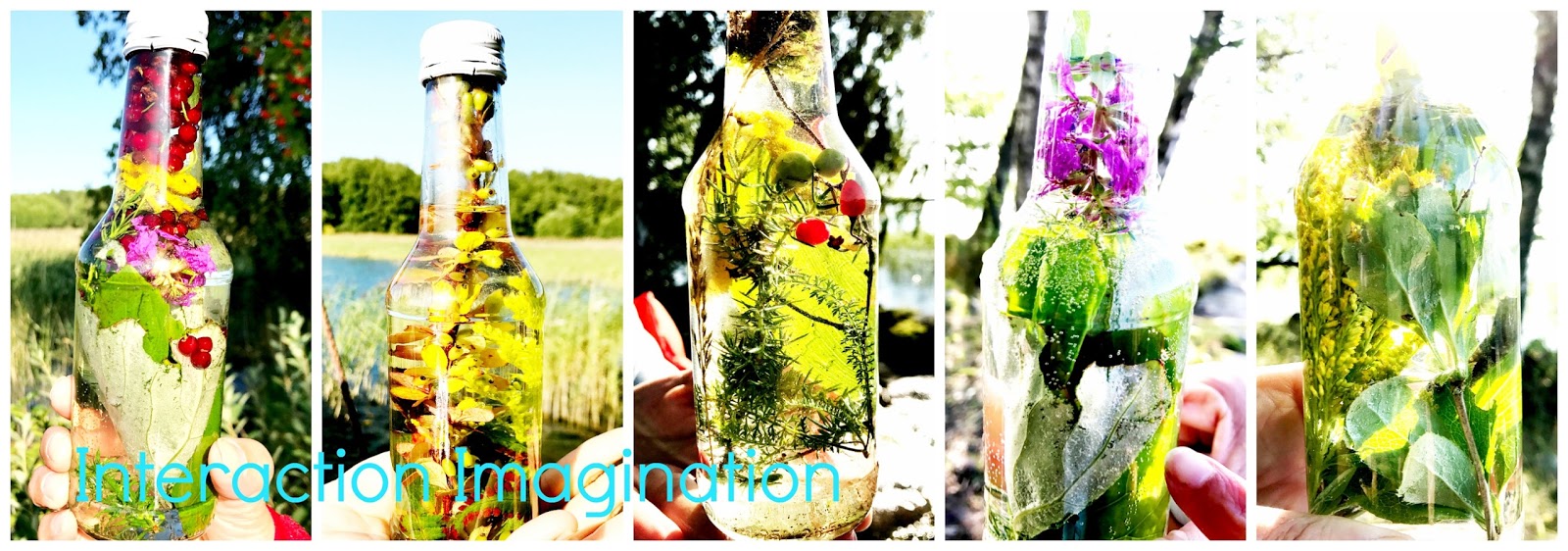
As part of the outdoor play and learning workshop we created bottles of nature. Since I had a focus on brining magic, imagination and creativity into play and learning the International Fairy Tea Party has been a great base for exploring these.
The idea was that the educators (I have also done this with children) should create their own magic potion, using what nature has to offer. I had 10 bottles of water... each filled to the brim, the purpose of this was so that water displacement could be experienced... as they put something into the bottle some water came out... some educators decided to empty a little water to create space... others just placed materials in carefully, and others enjoyed the splash of water coming out as they shoved more nature into their bottle... these are all different strategies and are worth while to observe as a teacher... do the children (or in this case educators) react as you though they would... do the observations give you more ideas about experimenting with water displacement?
No tools were given, so they had to find their own in nature to help get it down the narrow neck of the bottle... again this was with purpose to get children/educators thinking about problem solving.
In the forest there are things that should not be picked because they are endangered... this activity is a great way to share this information with children (and adults) in a meaningful way - to let them know that some leaves and flowers should not be in the bottle and explaining why).
As children/adults look for materials in the forest (or in any outdoor location of your choosing) the children get to see the small details, colours, textures, size, smells that maybe they would have missed. They make their own discoveries in nature.
When the children are satisfied with their bottle there is time to watch the sinking and floating, how the water and nature moves in the bottle if you put it upside down, or shake it... a chance to compare with others... how many have chosen the same things... why was that, what enticed them to putting that nature material in their bottles... this allows the children to see that sometimes the same material is chosen for very different reasons.
Then imagination can be brought back into the activity... what does their potion do... (reminding them that this is pretend) - is the potion meant to be bathed, in, wiped on the skin like a lotion, used on plants, on humans, as a medicine, to change things from one things to another... etc etc there are so many possibilities, really only the imagination can limit them... if you write down their words you have, as an educator, the chance to observe their language and communication skills. There is also the opportunity to take this further... to write stories about their magic potions (either together with the children if they are pre-writers - or let them write themselves if they are already writers and capable of creating their own stories on paper - drawing the story can also be an option). OR, the children could create a story together - thinking about what characters are in the story, what the potions do, For philosophical dialogues you could ask the children... are the potions for good or for bad., why are bad potions made.. how can the potions help people/animals/nature, which of the potions would be the most useful if they had to choose just one and why would it be the most useful...
The bottles I used were made of glass... of course plastic bottles can be used to... there could be an experiment with different size bottles, different shape bottles, different colour bottles... also the liquid used... one bottle could be oil, another water and a third vinegar etc so that over time the different processes could be observed - how do these liquids affect the nature inside them... if doing this maybe there is a need to have a more controlled content... ie the same number of berries, the same number of certain leaves etc...
The bottles can also be explored with light. We had painted on a sheet and when it was still wet we held it up with the sun shining through... we experimented with different materials to create shadows... including the bottles...
Other light sources can be used to explore the bottles - if you see in the film we did this... but think about doing this in the dark as well... or how about using UV light and giving the children the opportunity to experience the difference in colours... thus brining the nature bottles inside and connecting learning in and out.
Over time the bottles will change colour, the water quality will change, the contents will also change... many things the children can observe and ask questions about... or you as an educator can ask why the children think this is happening... thus children are given the chance to learn more about nature and science.
At the end of this post you can see a film I made about these bottles... including film footage of the bottles in action.
Of course there is the sensory value of these bottles too... to watch and be mesmerised with the finished bottles, using them as a calm down feeling. And during the collection process there is the smells and textures as well as the sounds and sights of the nature around them.
magic potions with preschoolers as part of an outdoor celebration of International Fairy Tea Party
magic potion making as part of an indoor celebration of International Fairy Tea Party ... indoors because of the fairy wings did not like rain... outdoor play came later when we took our wings off!!
Now for a few after photos... as I have kept these bottles for a year, and every now and again taken photos of them using different techniques... from sunlight, to torches and coloured light and also UV light...
sunlight - but why red? None of the other bottles went red despite containing the same berries... is it the mix of materials that has helped the red leach into the water...?
sunlight shadows
the mould growing is beautiful... this ONLY happened in one of the bottles
fairy lights to illuminate
looking at the details
fairy lights in front... behind and above and below... what difference does this make?
UV light... nothing in any of the bottles glowed... some just ended up VERY dark... if you want a contrast, make a nature bottle with tonic water... as that DOES glow with UV light.
more details . to watch how the colours change with time
Also interesting to watch how SOME of the bottle developed lots of particles at the bottom while others only a bit... so many differences and yet so many similarities to observe and compare and discuss.
During the last two weeks of being with the educators from Jenin, Palestine I have had the opportunity to view Swedish preschools (Stockholm and Vaxholm) through their eyes...
One of their questions throughout the study trip has been how do teachers do observations... as all the teachers have talked about that the teaching is based on their observations of the children. Most of the preschools we only visited for a short time, so that made it hard for us to observe the educators observing the children... and the preschools we visited for a longer period of time said that they were not doing any activities with the children yet because they were observing them... but the educators from Jenin could not see how the children were being observed.
When I asked about this it became apparent that this was not something that was actually being done at the preschool... and when you start scraping at the surface of this there is more to it than just it is not being done. The preschools we visited for a longer period of time are located in a suburb of Stockholm where there is mostly immigrants (and I say this not as a loaded word, as I too am an immigrant in Sweden, but my British passport has made me, maybe, a more desirable immigrant and therefore easier for me to be accepted in the Swedish society - but I would also like to point out it was not plain sailing for me either) - but in this suburb there is a need for high quality preschools, with well trained teachers... the problem is that attracting well trained teachers to this area is hard, and the ones that are working there are under an enormous strain as many of their colleagues working with the children have no education/training with young children or children at all.
Of course this was unfortunate for the educators from Jenin who were looking forward to learning how to observe the children... as the people they were shadowing were also in need of the same support. ( I will go more into this in a later post)
So this post is born from that... a need to take a look at observations...
After the summer holiday/vacation the children return to preschool, and for some reason some preschools have felt the need to start from scratch... even with children that have been with them for several years... no activities are put on because "we are observing the children"...
My question is what is being observed? Also, what do the educators need to know to be able to meet the children's needs...
These are questions that can be written down before the summer, almost like a standard cheat sheet sort of thing...
a teacher needs to know...
how has the child developed since before summer
gross motor skills
fine motor skills
language and communication
social
emotional
their interests
I think this is a good place to start... so to find out about these areas there is a need for activities to be able to see where the children are, and to be able to make plans for what each child and the group need for continued support through activities and interactions...
The educators need to think about how to check for the motor skills - providing activities that allow them to see how the child holds a pen, or uses the pincer grip, how they can sit on the floor or a chair, how the child walks, runs, jumps (with two legs, one leg) how they go up and down the stairs, how they climb... doing games, going to play spaces, working with beads, drawing and painting can all help the educator to learn more about the child - and through note-taking, photos, films and reflecting together with colleagues there is the chance to make plans as to what sort of activities are needed in the future... if many in the group have weak gross motor skills then there is no point doing lots of sit down activities and getting them to read and write, it is a much better investment to get outside (and inside) to do climbing, running games, exploring the forest (where the ground is uneven) etc etc where muscles and balance can be developed and strengthened that are all essential for concentration - even for being able to sit in a chair... weak stomach and back muscles make chair sitting hard (not that children need to be doing sit ups... but through climbing, crawling and balancing on logs/beams etc they can be strengthened)
How do you observe a language? This is something that needs to be discussed in your group of educators (as with all the areas)... you can look for do the children follow one step, two step or three step instructions? How complex are their sentences... a few words or more... how is the pronunciation... is there a need for blowing bubbles, eating chewy food etc to strengthen mouth muscles... are they following the thread of the dialogue or are they often going off topic (pragmatic language development)... Language can be observed and recorded by writing down what they say in group meetings (verbatim, including what the teacher says, so that you can see the interaction) - through individual interviews (where you can find out more about what they are interested in, what they like to play and also what they want to learn... I LOVE asking that question... you always get some interesting answers... and I always try to ask so that the children cannot hear each other and influence each other's answers). You can also observe language through listening to their play... writing, filming how they communicate with each other... is there a child dominating the conversations, are there others getting frustrated because they cannot communicate as efficiently as they want to? etc etc...
For the last five years I have started the year with International Fairy Tea Party... and through activities covering fairies and magic I have observed the children and listened out for their interests... I have also met with their parents to talk about what the children were interested in over the summer, what they have learned, if any fears have developed or any passions arisen... this then allows me to see the whole child... my observations, the children's point of view through the interviews and the parents observations... it gives me a better chance of getting the direction of our learning journey together right...
Also working with the same children over a period of years also helps with this so much, as I do not need to build the trust between myself and the children every year... we can just continue from where we left off, and that is truly a beautiful thing.
The fairy tea party has been a great way to start the year, magic and curiosity baked into the activities that have allowed the children to bond together as a group, as they share wonderous experiences together, this creates a feeling of safety, it also kick starts their imaginations and creativity that has really helped with projects that have followed on from the fairy tea party. And since we start with the same tradition every year there is no need to invent the wheel every time... just the need to tweak activities to improve them or adjust them to meet the needs of the group. This means that there is more time for the educators to observe and reflect on the children and group, rather than on the activities. And since we have done this for many years with children from 1-5 with different interests over the years, we have a wide array of activities, interactions, experiences for the children to participate in documented and reflected on. Of course the first year will take a bit more thinking and reflecting... BUT everyone has to start somewhere, and it is a good investment to have some kind of start-up tradition that allows educators to focus on observing the children in a manner that is structured.
Free play should always be a part of the day, so I am not talking about structured the entire day.
The director/pedagogical leader should be key in supporting educators in finding strategies into how to observe children, how to observe their learning, what learning needs to be prioritised (at any given time, maybe there are situations that need to be responded too), how these observations are collected as data, and how this data is analysed to provide the basis of continued learning.
Here are some posts that might help with learning more about observation making...
Reflecting on the usage of the light table - this post includes my reflections of my observations, so that I can better understand how the light table is being used and also how it can be improved.
Painting with one year olds - my observations of a session with one year olds, and the reasons this activity was chosen with that particular child.
Painting by letter/Testing boundaries - this post shows how my observations and a dialogue with others prompted this activity to further explore how the children interacted with each other when it came to boundaries, to better understand how I could support these children in their social interactions.
Clay and two year olds - this post shares my observations of a group of two year olds working with clay.
Observations - the Sherlock Holmes approach - this post explores some of the thinking behind observing children... how we can discuss with colleagues, how we can be aware of how we are observing and why we are observing.
Making learning visible - this post is about how the children were enables to observe their own development. I also knew that some of the children did not like to draw anything that was less than perfect... and this is why the Leonardo da Vinci project was in part suggested (and embraced) as da Vinci believed in learning from mistakes and practising until satisfied... this Really did help the children.
Pedagogical documentation - this is the first in series of posts about pedagogical documentation... this one focuses on observations and collecting data...
Democracy as a relationship - this is a reminder that observations should not be done in isolation, but together with colleagues, the children and the parents...
Progettazione - this post was written together with Debi Keyte-Hartland and is about a more in depth look at projects, the Reggio Emilia Approach way... how observations and interpretations of those observations support how to proceed with activities, projects and interactions with the children.
Co-documenters - this post is a reminder again of how the children are an important part of the process... that they too observe and have an opinion of how you collect your observations and that they can be interpreted together.
8 educators from Jenin, Palestine have been with me (that work on the refugee camp there) and we have visited various preschools, schools, and the teacher training college on a quest to learn more... I have held a full day play workshop and a two day outdoor learning workshop as well... with a BIG focus on imagination and creativity.
The aim has been to give them a new perspective... ideas and inspiration to take back with them and to adjust to fit in with their own context. Of course this time I have spent with them (starting in January with a 3 week visit to the camp, and then April for 2 weeks in the camp) has been an opportunity for me to see education from a new perspective... to appreciate the spaces available for children here in Stockholm, the money invested by the state into preschool and education and the fact that there is not the fear of my home being invaded by soldiers, or the sound of weapons EVERY DAY AND NIGHT that disturb sleep and make learning and concentration even harder.
There are many areas of life that need improvement in Stockholm... there are still far too many prejudices that are limiting far too many people's potential... and also forcing them to live without the feeling of safety and belonging that is the right of all people. There needs to be equality... for all... no matter where we originally come from, or what religion we believe in, what our gender is or what our sexual preferences are etc... we ALL have the right to reach our full potential, we have the right to be respected and to be valued. Sweden is a country that is not under occupation, it is a country not terrorised by nightly outbursts of weapons that wake whole neighbourhoods... we have the chance to really address these issues and create a country of equal opportunities.... and yet during my visits it is quite clear that this is not the case, there is still so much left to do so that ALL preschools in all areas are provided with the resources to give children the best start... and its not just academics but also the social interactions, integration, the feeling of really belonging.
Investing in all the people that work in preschools is essential... making each and everyone feel valued, and giving them all the training, the inspiration and the time to practice in order to give children that best start.. that the scaffolding is meaningful, reflective and joyful.
Adults need time to play. To find joy. To use their imagination and to train that creativity muscle that enables them to better connect with children, enables them to be a more inventive teacher - and also gives them the strength to dare... to try new things, to dare to make mistakes as part of the learning process.
and for these educators... being in a boat was all about joy... about awaking their inner child and laughing out loud. To forget their reality for a while to experience a bit of magic... and once filled with magic it becomes easier to create magic for others... to take magic back home to Palestine with them.
In the coming weeks I will be writing more about this last two weeks together with the educators from Palestine, my role in The Freedom Theatre's preschool teacher training programme... and what I have learned in this journey.
Yesterday I held a play workshop for the educators from Jenin, Palestine and some of the educators of Filosofiska preschools. it was an opportunity for experiences to be shared and to learn from each other... and to explore play...
The day started with a dialogue... exploring what "PLAY" means to each person... and then what "MAGIC" is...
After this they were given the challenge to explore materials and to discover magic... and not to play as children, but to play as themselves...
Here is some of the dialogue from the morning session... Names are not used... as it this post is only about sharing ideas...
PLAY
Play is with a message and
with a goal, but not always... for example in this training we have learned that if we want to
teach math we can teach through play and not just writing. This age (preschool) is for
playing not just learning...
Playing for children is like freedom
for adults, freedom without limits, the child can become more and more by
playing... allows the child to develop... Play is the the same for
children as freedom is for adults...
The kids invite to play... give them space to try and things, as a parent and as teacher... there is
difference between younger and older - there is a difference in their
needs... But we should not just let them be, but observe from a distance.
Playing should not be
limited, even if it is dangerous, the kids they love to try the
things, play comes from within... (talking about risky play)
Playing is a fun activity - happiness... in the end it has a goal for these children, adults
situate the things for the kids..
Play is the first job in the kids
in the world, it is a kind of power... the kids that do not play
will not develop enough..
Fun. to discover the world, I can
teach myself through play.
Play is exploring, taking
new perspectives, being able to change perspective in an instant, I
think both finding and exploring your inner self what you are
interested and like and what others are interested and like.
Cooperating about a fantasy world.
Play is exploring and but also a
state of mind... a joyous state of mind... play requires a possibility
mindset... to see possibilities... and what came before
Play is the most fun that exists... but also the most serious and most
important thing we have
Play is important for the
child, from play we can discover many new things, sensory is
important... yesterday we went to the preschool we discovered
something new in the room, through play we could discover many new
things... we need space for this kind of play.
Playing is life
Play is to explore the
different sides of your personality; and play helps to get to know
yourself and others on a deeper level. When you understand yourself
and others then you can function better. We are all children
actually.
MAGIC
Magic is something
difficult... it is fantasy she has wishes something like fairies and
it is like wishes... I wish to be a king...
When I think magic I think of
moments, there are often moments of magic that happens in meeting
with objects, humans, or realisation... play is magic... magic is
play.
Also think play is magic...
if they have the play and magic they also have the power... it is in
the play and magic that the children have their world outside of the
grown up world... so they can be free...
Its like wishes, its always
happening in he night when people are sleeping, then magic becomes
real... Everything is possible... (I can do everything)
Magic is a gate opener (door opener...)
The magic that the children in
their mind all the time... they love to use their imagination... the
fairy for the girls, she plays with the fairies and has a
conversation with them, it is part of the world with the kids...
I can talk a lot about magic but will just
say... for example if you look really close at things like the house
of a snail or a leaf... your perspective changes... life itself is
magic, you just have to have the right eyeglasses on to be able to
see... do not take life for granted.
Magic is to give children to to
live reality as they want to... adults say no a lot - this give
children freedom...
The magic is the surprised face
for the kids for example when you ask them to go and see bats in a cave...
to then go to the cave... and instead they "find" gold... here they give kids power
and life through magic... the most important is that magic gives
children happiness..
The kids live in imagination and the
magic they use... they need this imagination in everything. It is
like wishes... they need it to become a truth. (wishes to become real)
The magic in my
world is to let the children think and feel without us as adults –
that we take the time to be with the children in their world and be
with them and not outside and to be in communication with the
children... interaction, to allow them to be who they are, to allow
them to experience their own world is magical...
Magic is something that is
impossible that becomes possible. (there are a few giggles at this time as I point to my t-shirt with the word IMPOSSIBLE written on it but the first two letters are crossed out)
I agree with what I said
before... but that play and magic is important for adults too.. and
that it is power for us too... if we are imprisoned in a small room
and without freedom then we can be free in our imaginations
The educators then were asked to look for the magic not the learning in the activities set out for them. Below are some photos and films from the interactive hands on part of the workshop... and then there is some text from the afternoon session...
making prints... also magic
bubbles landing on the art and not popping straight away
being inspired to build upwards... to crate buildings
dialogue... taking time to explore our thoughts...
During lunch I had a dialogue with one of the Swedish teachers about the fact that I did not want to give my opinion about play or magic during the dialogue... my reason being that I was there to learn from them so that I could be a better teacher for them... that my opinion might sway how they think they should feel and at this point I felt it more important that they learn from each other, explore and then continue the dialogue. I said that this is also how I work with children during dialogues... that my opinion is put on the sidelines so that I can learn from the children to better equip myself to meet their learning needs. For this educator this was a powerful statement ... we went on from there to explore the word interfere... and I think a whole blogpost will come at a later date from this...
AFTERNOON.
Sharing magical moments from this
morning...
It was magical to see smiles
spreading on faces through interaction... dialogue and conversation
started from being together and doing together.
it was a nice moment when
talking to each other... got ideas from what she has made and
discovered an idea to build a mosque
Painting on the floor and
spraying... it created circles... I was so surprised as I did not know
it was going to happen... what i thought was going to happen turned
out different and I like to be surprised... that was magical... and
that we participated in the same painting together... so we do not
know the result... it is always changing... that is magical. Its also
like losing control, normally when you are grownup you have to have
control of everything and here we did not have to, it and it was
liberating.
The light table the plastic
usually to pop, but here to paint... at first I only used top of my
finger, and then by the end using the whole hand with (2 other educators)... that was a magic moment... the interaction between us as
adults and talked about many things, we talked about play for
children and how parents are in Sweden and Palestine.
The magic started at this table and started the dialogue and feel like the kids... the
challenges this is for me and for you, to imagine the train went to
the moon (at the tape and paper table)... bringing the story into the play
the magic for her
was the atmosphere, how there was harmony moving from activity to
the magic was you Suzanne when you
threw up the flowers...
Inside when painting with my hands and used the colour and also
when Suzanne asked about what I created and I imagined myself as a child and how the child thinks... making a bridge and going to the moon... and
this idea of being on the moon, to be honest I have never in my whole life thought I could imagine such things (there was then a dialogue about the importance of imagination and how many children in Palestine are restricted in their play as their imagination tends to be so reality bound)
The magic is to me was was playing with bubbles and mixing the colours together, so we
sat and tried...
And how did you mix them?
(she shows with her fingers)
the story room... I forgot to
check out the books, and I discovered many ideas for
magic there after I had played...
I started with the books so that she could get more
ideas
ME: would you start with the same thing? Or books next time?
start with the
stories...
ME: is it better to start with your
own inspiration or that from a book...?
to start with the story and
then she have inspiration from the stories to apply her idea...
in that moment … it
depends...
a mix of both of them... start
with own ideas... then read stories then you will have many ideas,
you can build it on your own ideas and then have new ideas... so both
of them working...
that
is magic to have a man here. (there was a male educator taking part, and this was of great importance and interest to the educators from Palestine where preschool educators are exclusively female)
I think I was a bit nervous
and I sat at the table... and I needed to play by myself and the
magic happened when you asked about the question... the question war
play. I often think conversations between grown ups are like our
version of play... (not just running around etc) we have this
interaction between speech and listening.
even if we did this part of playing
in Palestine they will only imagine their reality... the guns the
occupation... Swedish children can imagine more freely
(talk about Palestine and the need for
imagination... to escape the reality...)
when imagining are they butterflies or
stylised flowers all looking the same or tanks... but they all look
the same (templates) it is very much Disney style and sponge bob in Palestine...
that is why I am afraid of this kind of materials... it is stylised
fantasy... they are locked images...
and not relevant to Palestine...
how can I use paintings and
other images of a flower to open up the space for creativity and
imagination. Instead of looking at standard red/yellow flower... go
explore flowers in nature... to experience... flowers though new
perspectives... (not many flowers in the camp... mostly rubbish)
the scent in the paint... nice
addative... did not think of it myself...
also the scent is connected with
emotions and can bring that to the learning/experience
ME: science says that scent is the
biggest memory trigger... smells with positive memories can enhance learning while smells with negative memories make it harder to concentrate...
in our system at work in Jenin,
in our reality there is no man working in kindergarten...
ME: what good do you think will happen from
having men in preschool in Jenin?
There was then a long dialogue about men working in preschools, about gender differences and about making changes in Palestinian education and society... these topics I will take in another post as they are worth exploring on a deeper level.
But from the comments I have shared (this is of course not the entire dialogue) you can see that imagination and magic are important elements of play, and important for learning and important for change.
As I reflected over the day I realised that imagination needs space... place and time... it also needs safety... as it became clear that if adult educators could not imagine they would talk about flying trains and going to the moon then the reality of occupation and fear has been so overwhelming that there has not been space for imagination.
So how do we create this space for the children in Jenin right now... these educators are an important part of this... as are all educators and people who work and come in contact with children... to create space where children feel safe enough to imagine...
and by exploring imagination there is the hope that creative thinkers emerge...
and creative thinkers can become problem solvers, and maybe even conflict resolvers.
How do you ask questions?
Questions beginning with "why" often leads to a surprising answer or a refusal to answer the question at all. Whereas a question that starts with "tell me about" can lead to detailed observations from a child.
How often do take the time to reflect on how you ask questions?
Get creative with your questions... try something new and see what happens
in this case... creativity involves breaking out of established patterns in order to question things (or to dialogue with the children) in a different way.
Stockholms Pedagogiska Vägg (Stockholm's Pedagogical Wall) is designed for children to get creative in the public space... a space for children to leave their mark, their ideas, their imagination - not for a long time but for a while, as the wall is painted over and over very much like the Together Paintings I have described before ( you can read about them here).
It is a wall that is forever evolving. A place to come as an individual, or a family or together with a preschool or school or fritids (after school activity centre).
The wall is available for free expression or as part of a workshop together with an art facilitator that will inspire and challenge thinking about art, creative expression, and children's rights in public space.
I met up with Rikard Olsen who started the project with backing from Stockholm city with the aim to promote children's rights to take more place in public spaces. This project has had a steady trickle of visitors over the summer, as well as schools and preschools visiting too to do workshops where art and movement are combined.
The aim is for the wall to continue after the summer - with workshops for schools and preschools to continue and also at weekends.
I think the wall is important for several reasons...
Children need to be a part of the public space... not only so they can see themselves as active participants of the society and not just beings that adults create spaces for... but also so that adults can see the competence of children. That their ideas are given space to be aired, that their talents can be shown off... and this wall is open for ALL children of ALL ages and even during the short time that I was there I saw a huge range of ages and Rikard had a natural instant good rapport with them all.
children benefit from doing art outside, where there is an opportunity to experiment with paints and materials in a way that indoor art seldom allows you
the wall is massive... if allows children to think big, no small paper here, there is space to really go wild, to paint with the whole body - to stretch high and bend low and paint big.
there is the chance for risky-play. I love the fact there are step-ladders, over the years I have taken step-ladders into the atelier (and other spaces) for the children to climb and experiment with taking risks - in the sense of how high do you dare to climb. Each child will find that step that they dare use, some will challenge themselves, others will watch until they find the courage themselves... parents and teachers get the chance to see that children are capable of using step ladders... even preschool children!!
we often talk of making children's learning visible... and this is a space that also does that. the children are learning about techniques, they will learn about the difference between brush and roller (and other materials used) - they can learn about mixing colours, they can learn about how other children express themselves and be inspired, on the wall this time were various languages... so we were learning that this is a space of diversity where all are welcome.
it is a place to interact. Not just with the wall and the materials... it can also be a space to interact with others. A meeting place.
If I was to sit here longer I would probably come up with more reasons for why this wall is important... these are the ones that have just rolled off the top of my head.
If you are in Stockholm then I recommend that you head to T-bana Medborgarplatsen and check out the wall, take along children and let them get creative. if you work at a school or preschool why not get in contact with them and see if you can book a session/workshop (the link to the page and a way of contact is at the top of this blogpost)
I really hope this wall goes from strength to strength and encourages others to take action and ensure that children are a part of public spaces.
If you are interested in children's rights and children and public spaces, then please check out the facebook group Children and Public Spaces
As the new academic year is about to kick off here in Sweden I thought I would start a new series of posts... well mini posts...
basically just a question, or a thought or a reflection that I have come across as I read, or observe or just reflecting... and instead of waiting for these reflections and thoughts to manifest into a whole post of some sort... i just write it down and share...
So here comes the first one...
Why are children perceived and written about in a certain way? And what concepts and from which pedagogical practices does this image of the child come from?